


Setting the right rent price is the single highest-leverage decision an Indianapolis landlord makes — and most get it wrong in one direction or the other. Price too high, and you rack up vacancy costs that quietly destroy your annual returns. Price too low, and you leave hundreds or thousands of dollars on the table every year. For a complete breakdown of the data, tools, and frameworks behind how much rent to charge in Indianapolis, our comprehensive pricing guide covers every variable in depth. This post takes a more focused, step-by-step approach — giving Indianapolis landlords the practical process needed to price confidently, compete effectively, and protect their ROI in 2026.
Contents
Overpricing and Underpricing Both Damage Your Returns — Here Is What Each Costs
Most landlords fear underpricing. But overpricing is actually the more common and more damaging mistake in the Indianapolis rental market. Understanding the real financial cost of each error is the first step toward taking rental pricing seriously as a strategy rather than a guess.
| Pricing Error | Immediate Impact | Annual Cost Estimate (on a $1,500/mo rental) |
|---|---|---|
| Overpriced by $100/month | 30–45 day vacancy instead of 15–20 days | $750–$1,500 in lost rent from extended vacancy alone |
| Overpriced by $200/month | 60+ day vacancy; lower applicant quality | $3,000+ in lost rent; potential tenant quality compromise |
| Underpriced by $100/month | Fast placement, but immediate revenue gap | $1,200/year in unrealized income on a 12-month lease |
| Underpriced by $150/month | Strong demand, but below-market tenant expectations | $1,800/year in revenue lost; harder to raise to market at renewal |
| Priced at market rate | 15–20 day average vacancy; qualified applicant pool | Maximum net income with minimal turnover friction |
The math is straightforward: a 30-day vacancy at $1,500 per month costs $1,500. Pricing $75 below market to avoid that vacancy costs $900 per year — and makes it significantly harder to reach market rate at renewal without risking a move-out. Market-rate pricing from day one is always the financially optimal starting point.
The Four Data Sources Every Indianapolis Landlord Should Consult Before Setting a Price
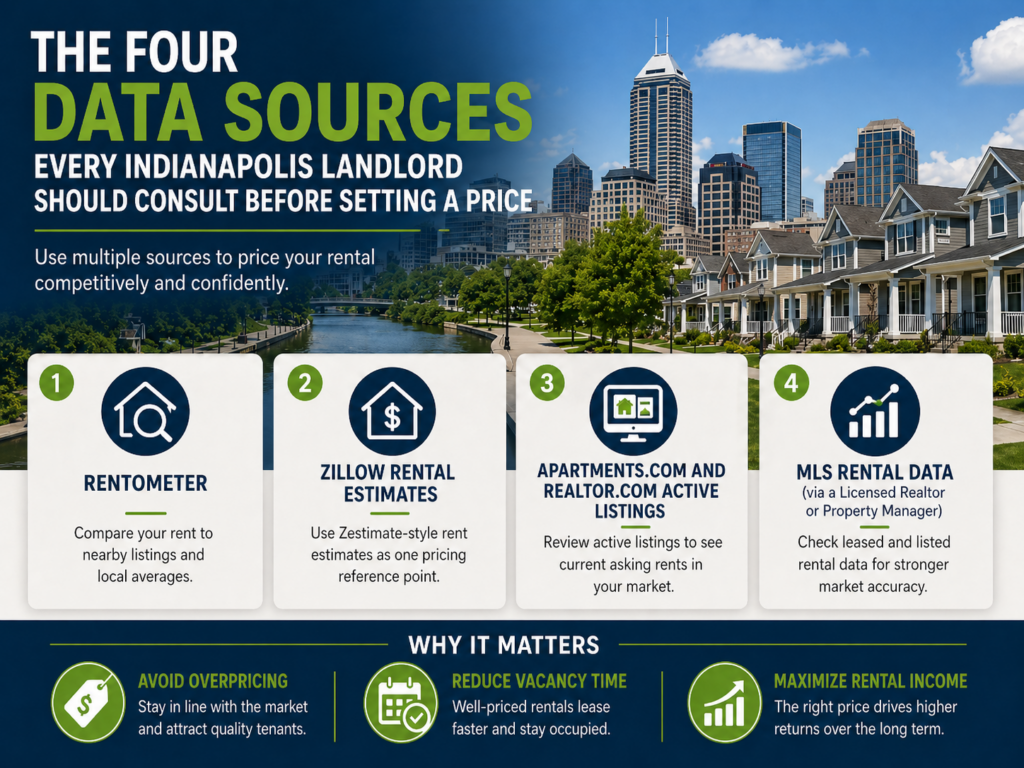
Accurate rental pricing in Indianapolis requires triangulating across multiple data sources rather than relying on any single platform or estimate. Each source has blind spots, and the convergence of multiple signals produces the most defensible and accurate price.
- Rentometer: Enter your property address and bedroom count to receive an instant percentile ranking against comparable rentals in your zip code. Aim to price between the 40th and 60th percentile for fastest leasing velocity with minimal revenue sacrifice.
- Zillow Rental Estimates: Zillow’s automated estimate aggregates active listings and recent placements. It is most accurate in high-density neighborhoods with ample comparable data. Always validate against active listings — not just the estimate — by browsing current Zillow rentals manually in your zip code.
- Apartments.com and Realtor.com Active Listings: Browse three to five properties currently listed in your neighborhood with similar bedroom count, square footage, and condition. Note how long they have been on the market. Listings sitting 30+ days with no price reduction are likely overpriced; listings gone in under a week suggest the market can bear more.
- MLS Rental Data (via a Licensed Realtor or Property Manager): The Indianapolis Board of REALTORS MLS contains actual placed rents, days-on-market figures, and concession patterns — data not visible to the public. This is the most accurate source available and the primary tool Discover Properties, LLC uses when pricing rentals for our clients.
Cross-referencing all four sources typically produces a tight price range of $75–$150. Set your listing at the midpoint of that range and monitor applicant activity during the first seven to ten days.
Property Features That Justify Premium Rents in Indianapolis — and By How Much
Once you establish your neighborhood’s baseline rent range, the specific features of your property determine where within that range — or above it — you should price. Not all upgrades carry equal weight with Indianapolis tenants in 2026.
| Feature or Amenity | Estimated Rent Premium | Notes |
|---|---|---|
| In-unit washer/dryer (provided) | $75–$150/month | Highest-impact single amenity for Indianapolis tenants; accelerates placement |
| Updated kitchen (new appliances, counters, cabinets) | $75–$200/month | Premium strongest in mid-range and suburban neighborhoods |
| Luxury vinyl plank or hardwood flooring | $50–$125/month | Replaces carpet; reduces turnover cleaning costs too |
| Dedicated off-street or garage parking | $50–$150/month | Especially valuable Downtown, Broad Ripple, and Mass Ave |
| Fenced yard (single-family homes) | $50–$100/month | Strong demand driver for families and pet owners |
| Central A/C (vs. window units) | $50–$100/month | Expected standard in most Indianapolis neighborhoods; absence requires discount |
| Premium school district (Carmel Clay, HSE, Zionsville) | 10–25% above neighborhood average | Location-based premium that persists regardless of property condition |
| Recently renovated bathroom | $50–$100/month | Modern fixtures and tile deliver strong perceived value relative to cost |
Premiums are additive — a property with in-unit laundry, an updated kitchen, and a fenced yard in Fishers can realistically command $200–$400 above the base neighborhood rate for its bedroom count. However, premiums must still be validated against actual comps. Stacking features does not override what the local market will bear.
Indianapolis Neighborhood Rent Ranges by Bedroom Count for 2026
Indianapolis neighborhoods vary significantly in achievable rents. Use this reference table as a starting point for your pricing research, then refine with live comparable data for your specific property type and condition.
| Neighborhood / Area | 1BR Average | 2BR Average | 3BR Average | Market Profile |
|---|---|---|---|---|
| Downtown Indianapolis | $1,200–$1,800 | $1,600–$2,200 | $2,000–$2,800 | High demand; walkability; young professionals |
| Broad Ripple | $1,000–$1,500 | $1,400–$1,900 | $1,800–$2,400 | Entertainment district; strong rental demand year-round |
| Fountain Square / Mass Ave | $950–$1,400 | $1,300–$1,800 | $1,700–$2,300 | Arts community; revitalizing; growing tenant base |
| Carmel | $1,100–$1,600 | $1,500–$2,100 | $1,900–$2,700 | Top-rated schools; suburban amenities; family demand |
| Fishers | $1,050–$1,550 | $1,400–$2,000 | $1,800–$2,500 | Fast-growing; family-oriented; strong retention rates |
| Noblesville / Westfield | $950–$1,400 | $1,300–$1,850 | $1,700–$2,300 | Suburban growth corridor; affordable relative to Carmel/Fishers |
| Greenwood / Southside | $850–$1,250 | $1,100–$1,600 | $1,400–$1,900 | Value market; steady demand; longer lease terms common |
| Lawrence / Speedway / Beech Grove | $750–$1,100 | $950–$1,400 | $1,300–$1,800 | Affordable; working-class; budget-conscious tenant pool |
These ranges reflect well-maintained, market-ready properties. Properties with deferred maintenance or dated finishes should be priced at or below the lower bound of each range. Properties with premium upgrades and strong school district access can push toward or above the upper bound.
When and How to Adjust Rent Without Losing Quality Tenants at Renewal
Setting the right initial price is only half the equation. Managing rent over time — particularly at lease renewal — is where Indianapolis landlords either protect their returns or inadvertently trigger costly turnovers.
- Benchmark against current market before every renewal. Run a fresh Rentometer check and review active comps 90 days before the lease expires. If your current rent is 10% or more below market, a phased increase over two renewal cycles is less disruptive than a single large jump.
- Keep annual increases below 5–8% for quality tenants. Research consistently shows that increases in this range maintain acceptable retention. Increases above 8–10% significantly elevate move-out probability — and a single turnover (vacancy + cleaning + marketing + screening) typically costs $1,500–$3,000, erasing the revenue gain from a large increase.
- Give 60–90 days’ notice, not just the legal minimum. Indiana requires 30 days’ notice for month-to-month leases, but providing 60–90 days signals professionalism, gives tenants time to budget, and reduces the likelihood of an emotional or reactive move-out decision.
- Time new listings for peak season when possible. If a lease ends in the fall or winter, consider offering a short-term renewal extension to align the next turnover with April–August — Indianapolis’s peak leasing window — where you’ll face less vacancy risk and stronger pricing leverage.
- Document your market justification. When presenting a rent increase, briefly noting that neighboring comparable properties are renting for X amount depersonalizes the conversation and grounds the increase in market reality rather than arbitrary landlord discretion.
Let Discover Properties, LLC Price and Manage Your Indianapolis Rental
Rental pricing done right is not a one-time decision — it is an ongoing process of market monitoring, property positioning, and strategic adjustment. At Discover Properties, LLC, we bring Indianapolis landlords the local market knowledge, live comparable data access, and full-service operational infrastructure to keep every property priced competitively and performing at its full potential year-round.
Whether you own one property or a growing portfolio across Marion County and the surrounding suburbs, our team is ready to help. Call us at 317-254-8888 or contact Discover Properties online to schedule a rental pricing consultation today.
Frequently Asked Questions
What is the average rent for a two-bedroom apartment in Indianapolis in 2026?
Average two-bedroom rents in Indianapolis range from approximately $950 in affordable neighborhoods like Lawrence and Speedway to $2,200 in premium areas such as Downtown and Carmel. Most mid-range Indianapolis neighborhoods average $1,300 to $1,700 for a well-maintained two-bedroom unit, with price variation driven by condition, finishes, and proximity to employment centers and top-rated schools.
How do I know if I am charging too much rent for my Indianapolis property?
The clearest signal is extended vacancy. If your listing has been active for more than 21 days without a qualified applicant, your price is likely above market. Cross-reference your rate against three to five active comparable listings in the same neighborhood using tools like Rentometer or Zillow to determine how far above the competitive range you are sitting.
Does upgrading my rental property allow me to charge more rent in Indianapolis?
Yes. Strategic upgrades to kitchens, bathrooms, flooring, and appliances can justify rent increases of five to twenty-five percent depending on the neighborhood and competing inventory. The highest-return upgrades for Indianapolis landlords are in-unit laundry, updated kitchen appliances, and luxury vinyl plank flooring — features tenants consistently prioritize when comparing listings.
How much notice is required to raise rent in Indiana?
Indiana requires at least 30 days’ written notice before a rent increase on a month-to-month tenancy. For fixed-term leases, rent cannot be increased during the lease term unless the agreement specifically allows it. Discover Properties recommends providing 60–90 days’ notice as best practice to maintain tenant relationships and improve lease renewal rates.
What is the best time of year to list a rental property in Indianapolis?
April through August is the strongest leasing season in Indianapolis, driven by families moving during summer to avoid disrupting the school year and by professionals starting new employment. Landlords listing during this window benefit from the largest applicant pool and the strongest pricing leverage. Winter listings typically require more competitive pricing or move-in incentives to achieve timely occupancy.
How can Discover Properties help me set the right rent for my Indianapolis rental?
Discover Properties, LLC provides Indianapolis landlords with professional rental pricing analysis backed by current market data, live MLS comparable research, and deep knowledge of neighborhood-level trends across Marion County and surrounding suburbs. Our full-service property management team handles pricing, marketing, tenant screening, and ongoing rent optimization so your property stays competitive and profitable. Call us at 317-254-8888 to get started.
Comments are closed.